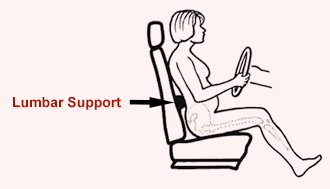
Driving a car is a continuous vigilance task in a very fixed sitting posture. Unlike sitting
in an office chair, safety factors prohibit regular weight shifting when driving. As a result, it is
critical to drive in one's most optimal healthy and alert sitting posture.
Many women, however, know that something is not right. They are instinctively aware
that by conforming their bodies to car seats, they are gradually distorting their postures and
harming their health.
The potential harm begins as soon as a woman leans against the car backrest. Her trunk
collapses due to inadequate support for the pelvis and rib cage. Lack of stabilization to these two
critical areas can lead to harmful effects on a woman's posture and health.
IMPORTANCE OF PELVIC STABILIZATION
An open space is necessary at the lower end of an office chair's backrest to provide
adequate space for the posterior protrusion of the buttocks. Without the provision of a large open
space, the buttocks will be pushed forward on the seat, inducing a slumped sitting posture.1-3 Car
backrests lack such an open space, at best having only a slight recess for the buttocks.
Due to soft tissue differences between the sexes, females in general have a larger gluteal
prominence than males.4,63 Women will therefore tend to be pushed further away from the lower
backrest when driving, making backrest contact primarily in the gluteal region. This leaves the
pelvis unsupported, resulting in pelvic instability when driving.
According to Branton, the freedom of the pelvis to move, which occurs in all sitting
postures when the upper sacrum is not supported by a backrest, results in relatively fast
oscillatory movements of the pelvis rocking over the ischial tuberosities.5 The exposure to
vertical vibration and road shock on the seat when driving intensifies this rocking motion of the
pelvis, thereby increasing the bending stresses to the lower lumbar spine.6,7
Trunk muscle fatigue from vibration impairs the driver's ability to sense a change in
pelvic and lumbar spinal position.8-10 Therefore, support to the sacrum is critical to assure
accurate positioning of the pelvis at all times when driving. Proper lumbar spinal posture when
driving depends directly on the position of the sacrum and pelvis.11 Sacral support may also
help relieve posterior pelvic pain, a common site of pain for pregnant women.12
As opposed to advocating sacral support for proper pelvic stabilization when driving,
many health professionals continue to recommend lumbar support instead. This results in three
major problems:
1. Lumbar support is placed too high to control the oscillatory movements of the
pelvis rocking over the ischial tuberosities.13
2. Lumbar support displaces the upper trunk behind the hips.3,13,14 This moves the driver further away from the steering wheel and windshield. The driver usually adapts to this postural distortion by increasing the thoracic kyphosis, rounding the shoulders, and bringing the head forward.15 Maintaining this posture when driving increases stress to the neck and upper back.
3. Lumbar support results in a relaxation and overstretching of the lower abdominal muscles, critical postural muscles for both sitting and standing posture.3,13
IMPORTANCE OF RIB CAGE STABILIZATION
 |
Figure 1:
Circle denotes area of the thoracic spine responsible for the hinging forward of the rib cage towards the pelvis. Adapted from Bennett, H.E.: School Posture and Seating. Boston, Ginn and Company, 1928.
Note: Although not shown here, the "hinge area" for spinal flexion also includes L1, the uppermost lumbar vertebra. |
The typical car backrest in the region of a woman's thoracic spine is a combination of
excessive recline, concavity, and softness. When a woman driver leans against such a backrest,
the result is a "postural depression," with the front of the rib cage hinging forward and downward
towards the pelvis.13,16,17. The greater the gluteal prominence, the greater the postural
depression, as a woman must lean further back before contacting and collapsing her trunk into
the backrest.
This approximation of the rib cage to the pelvis when driving is due to flexion of the
lower thoracic spine.3,13,18-22 (See Figure 1.) The lower thoracic spine is the region where the
extensor mechanism of the spine is the weakest, and is called the "hinge area" for spinal flexion.12,23,24 Lumbar support does not stabilize this critical area of the spine.
The hinging forward and downward of the rib cage towards the pelvis from the typical car
backrest results in an increased thoracic kyphosis when driving. This increased thoracic
kyphosis should be of much concern to women of all ages for the following reasons:
1. Up to fifty-one percent of healthy women from ages twenty to sixty-four are
kyphotic in their normal posture.25
2. Compared to younger and older age groups, the most dramatic decline in thoracic extension mobility occurs in women in their thirties and forties.26
3. Beyond approximately age forty, the rate of increase in thoracic kyphosis is much higher in women than men.27
4. An increased thoracic kyphosis occurs during pregnancy.28
5. An increased thoracic kyphosis is characteristic of women who habitually wear high-heeled shoes.29
6. An increased thoracic kyphosis is characteristic of women who overdevelop the upper rectus abdominis muscle with sit-ups and crunches.3,13
7. A woman's breast development increases the forward bending moment on the thoracic spine via the rib cage.
8. A habitual postural kyphosis can play a role in bone remodeling among healthy premenopausal women.25
9. T11 and T12, the vertebrae located at the "hinge area" for spinal flexion, are the most frequently deformed vertebrae in postmenopausal women.30
Preventing and correcting the postural depression and the increased thoracic kyphosis
when driving require firm support localized to the lower thoracic spine (T10 - T12). This lower
thoracic support will elevate and stabilize the rib cage, and elongate the spine. Head, neck, and
shoulder posture will all be dramatically improved through firm support to the lower thoracic
spine.
CLOSED-CHAIN LINK SYSTEM FOR DRIVING
The human body can be compared to an open-chain system of links that allows free
movement at the various joints.31 Sitting, however, involves a spontaneous attempt to stabilize
the body segments.32 This need for stability demands a closed-chain system of links.
The stability and consistency required for maintaining one's driving posture and operating
the controls (steering wheel, foot pedals) necessitate such a closed-chain link system.33 The
healthiest and most efficient closed-chain link system for driving involves stabilization of the
trunk through proper activation of the diaphragm, transversus abdominis, pelvic floor muscles,
and the lower thoracic erector spinae.13,14,17,59
Proper activation of the transversus abdominis is achieved by a "belly-in" position of the
lower abdomen.34-37 This is facilitated by maintaining gentle pressure against the sacral support
in a backward and upward direction.13,14,34 This slight movement results in a simultaneous reflex
activation of the lower thoracic erector spinae and pelvic floor muscles.23,34,59
The firm pressure from the lower thoracic support against the T10 - T12 region of the back
when driving immediately facilitates proper diaphragmatic breathing by eliciting the intercostal-
to-phrenic reflexes.38,39
(Phrenic motoneurons have been demonstrated to be under the control of reflexes elicited
by afferent stimulation of the lower intercostal nerves and the dorsal rami of the lower thoracic
spinal nerves. Mechanical stimuli applied to the lower thoracic region, such as pressing on the
back muscles or on the lower part of the rib cage, have been shown to have an excitatory effect
on the diaphragm from an increase in phrenic motoneuron activity.38
While the intercostal-to-phrenic reflexes can be facilitated with proper lower thoracic
support at the T10 - T12 level, afferent stimulation at the mid-thoracic level (T5 - T6) will actually
inhibit phrenic motoneuron activity.40,41 This is why the abnormal pressure stimulation against a
woman's upper back from typical car backrests impairs diaphragmatic breathing.)
Breakdown of Closed-Chain Link System
When driving in a position of postural depression, this important closed-chain link
system breaks down, and affects both a woman's internal organs and her musculoskeletal system.
Increased Intrapelvic Pressure
Driving in a postural depression results in a relaxation
of the transversus abdominis and a lowering of the diaphragm. With the decreased support from
a relaxed lower abdominal wall, together with the lowering of the diaphragm and ribs, the
abdominal organs are forced downward.42 For women, this results in the intestines exerting a
direct downward pressure on the uterus.15,43-46 This can be an overlooked cause of pelvic, back,
and menstrual pain, and of general fatigue.
Protruding Lower Abdomen
Incorrectly attributed to a lack of exercise or an
improper diet, a protruding lower abdomen develops from the relaxation of the lower abdominal
muscles (specifically the transversus abdominis) and the lowering of the diaphragm, ribs, and
abdominal organs. This gradual loss of lower abdominal muscle tone increases the stress to the
lower back.
Loss of Pelvic Floor Muscle Tone
Along with the relaxation of the transversus
abdominis muscle in a collapsed trunk posture, there is a simultaneous relaxation of the pelvic
floor muscles. The abnormal stress from prolonged driving with relaxed pelvic floor muscles
can result in pelvic and rectal pain. Over years, the gradual weakening of the pelvic floor
muscles from improper sitting can be a contributing factor in developing stress incontinence.
Impaired Breathing
Due to the relaxation of the lower abdominal muscles and the
resulting lowered resting position of the diaphragm, a collapsed trunk posture restricts
diaphragmatic breathing. With diaphragmatic breathing restricted, upper chest breathing
predominates, leading to shallow inspiration and a chronic state of fatigue.
Upper chest breathing increases the respiratory load placed on the scalene muscles, the
neck muscles attached to the upper two ribs. The scalene muscles normally contribute to
inspiration through elevation of the upper two ribs. However, when upper chest breathing
predominates, the scalene muscles are overworked.
The tendency for the rib cage to move in a downward direction when driving in a position
of postural depression also results in a greater load on the scalene muscles to elevate the upper
rib cage against gravity.60,61 Overuse of the scalene muscles not only strains the neck, but may
also activate "trigger points" in these muscles. The resulting referred pain from these trigger
points along the medial border of the scapulae and down the arms and hands resembles the pain
pattern of carpal tunnel syndrome.62
Lower thoracic support to the T10 - T12 region when driving is critical for decreasing the
stress placed on the scalene muscles for two reasons:
1. Mechanical support to the lower thoracic spine (T10 - T12) elevates the rib cage and prevents its downward movement. This mechanical support immediately reduces some of the static load on the scalene muscles.
2. The pressure from the lower thoracic support against the lower thoracic region of the back immediately facilitates proper diaphragmatic breathing by eliciting the intercostal-to-phrenic reflexes.38,39
Round Back Posture
A woman remains in a round back posture for as long as she
drives in a postural depression. Eventually, she maintains the same round back posture when
standing up.
Unfortunately, a round back posture only receives attention in our society as the
characteristic fixed posture of many elderly postmenopausal women with osteoporosis.
However, the constant abnormal stress to the spine from a habitual slumped, round back posture
can permanently alter the shape of the spine in healthy premenopausal women!25
It is not surprising that women have a much higher incidence than men of upper back and
neck pain, as these pain syndromes are associated with a slumped, round back posture.52
Safety Issues
Driving in a postural depression results in an increased thoracic kyphosis, round
shoulders, and a forward head posture.17 In such a driving posture, rotational head movements
are decreased, limiting the driver's field of vision.33,47
Backward nodding of the head is not possible when driving with a forward head
posture.47 The loss of head motion in extension with this posture may explain why a whiplash injury can result from a negligible rear-end impact.33
Important Note: For optimal protection against a whiplash injury from a rear-end
collision, the headrest should gently contact the back of the head when driving.48 Unfortunately, this headrest position is difficult to achieve in most automobiles due to a lack of headrest
adjustability.
Additional Factors Breaking Down Closed-Chain Link System
Pelvis Migrating Forward on Car Seat
Several factors contribute to the pelvis sliding forward on the seat when driving, leading
to a postural depression and a breakdown of proper trunk stabilization:
1. Driving with extreme extension of the knees to reach the foot pedals increases the tension in the hamstring muscles. This hamstring tension pulls the pelvis forward on the seat in a position of excessive posterior rotation.
2. Movements of the lower extremity with braking and accelerating tend to pull the pelvis forward on the car seat.49
3. Vertical vibration on the seat has a similar effect, causing the pelvis to slide
forward on the seat.50
Suggestions to prevent the pelvis from sliding forward on the seat, in order to maintain
the integrity of the closed-chain link system for driving, include:
a. Moving the car seat slightly forward to increase the knee flexion and reduce the tension on the hamstrings. It is important to note, however, that excessive knee flexion, while being beneficial in relaxing the hamstrings, can be disadvantageous for the application of force to the brake pedal.51
b. A stationary inclined footrest, located to the left side of the brake pedal, enables the left lower extremity to exert effective counter-pressure for preventing the forward migration of the pelvis on the seat.3,33
c. Using a seat cover of woven fabric. As opposed to slippery seat covers such as leather or vinyl, the beneficial friction from a woven fabric keeps the pelvis from sliding forward on the seat.
Elevated Arm Posture to Steering Wheel
The least stressful and fatiguing position for the arms, neck, and back when driving is
with the upper arms hanging vertically at the hip line.52 However, the commonly recommended
ten o'clock - two o'clock hand positions on the steering wheel disturb this balanced vertical arm
posture, resulting in a forward flexion of the upper arms.53
This elevated arm posture increases the forward bending moment on the thoracic spine
via the rib cage.19 The closed-chain link system breaks down, leading to round shoulders and a
round back, along with excessive tension in the neck and upper back.54
The forward flexion of the upper arms can be reduced when driving with lowered hand
positions on the steering wheel, such as nine o'clock - three o'clock or eight o'clock - four
o'clock.
Excessive Backrest Inclination
A slight backrest inclination (approximately 10°) when driving is important to stabilize
the body with accelerating, braking, cornering, and other movements of the vehicle. As opposed
to a fully vertical driving posture, shifting some body weight to the backrest helps reduce the
spinal stress from road shock and vibration.55-57
An excessive backrest inclination when driving distorts the proper upright relationship of
the head, neck, and upper back due to the visual requirements of driving. In order to achieve the
proper visual angle and distance to the windshield, the driver pulls her head, neck, and upper
back forward. In addition, the greater the backrest recline, the more the upper arms are flexed
forward to reach the steering wheel, adding further stress to the neck, shoulders, and upper
back.13
An excessive recline also distorts the proper upright relationship of the thorax and pelvis,
by displacing the thorax behind the pelvis.3,13 Such a reclined posture relaxes the lower
abdominal wall and depresses the diaphragm,15,58 with the driver having the same trunk muscle
activity as an unconscious person! The end result is a total breakdown of the closed-chain link
system of trunk stabilization that is essential to women's posture and health throughout life.
REFERENCES
1. Taylor, H.L.: Results of research on conditions affecting posture. Journal of the American Medical Association, 68:327-330, 1917.
2. Dresslar, F.B.: School Hygiene. New York, Macmillan, 1917.
3. Zacharkow, D.: Posture: Sitting, Standing, Chair Design and Exercise. Springfield, Thomas, 1988.
4. Stagnara, P., DeMauroy, J.C., Dran, G., Gonon, G.P., Costanzo, G., Dimnet, J., and
Pasquet, A.: Reciprocal angulation of vertebral bodies in a sagittal plane:
approach to references for the evaluation of kyphosis and lordosis. Spine, 7:335- 342, 1982.
5. Branton, P.: Behaviour, body mechanics and discomfort. In Grandjean, E. (Ed.):
Proceedings of the Symposium on Sitting Posture. London, Taylor and Francis, 1969, pp. 202-213.
6. Sandover, J., and Dupuis, H.: A reanalysis of spinal motion during vibration.
Ergonomics, 30:975-985, 1987.
7. Sandover, J.: Behaviour of the spine under shock and vibration: a review. Clinical Biomechanics, 3:249-256, 1988.
8. Wilder, D.G., Woodworth, B.B., Frymoyer, J.W., and Pope, M.H.: Vibration and the
human spine. Spine, 7:243-254, 1982.
9. Brumagne, S., Lysens, R., Swinnen, S., and Verschueren, S.: Effect of paraspinal muscle vibration on position sense of the lumbosacral spine. Spine, 24:1328-1331, 1999.
10. Taimela, S., Kankaanpää, M., and Luoto, S.: The effect of lumbar fatigue on the ability to sense a change in lumbar position. Spine, 24:1322-1327, 1999.
11. Wiles, P.: Postural deformities of the anteroposterior curves of the spine. The Lancet,1:911-919, April 17, 1937.
12. Östgaard, H.C., Zetherström, G., Roos-Hansson, E., and Svanberg, B.: Reduction of back and posterior pelvic pain in pregnancy. Spine, 19:894-900, 1994.
13. Zacharkow, D.: ZACKBACK Sitting. Rochester, ZACKBACK International, 1998.
14. Zacharkow, D.: The problems with lumbar support. Physical Therapy Forum, 9(35):1,3-5, 1990.
15. Kellogg, J.H.: Observations on the relations of posture to health and a new method of studying posture and development. The Bulletin of the Battle Creek Sanitarium and Hospital Clinic, 22:193-216, 1927.
16. Anderson, T. McC.: Human Kinetics and Analysing Body Movements. London,
Heinemann, 1951.
17. Zacharkow, D.: Sitting posture: the overlooked factor in carpal tunnel syndrome. Advance for Physical Therapists, 5:8-9,17, May 16, 1994.
18. Humphry, G.M.: A Treatise on the Human Skeleton. Cambridge, MacMillan, 1858.
19. Vulcan, A.P., King, A.I., and Nakamura, G.S.: Effects of bending on the vertebral column during +Gz acceleration. Aerospace Medicine, 41:294-300, 1970.
20. Alexander, C.J.: Scheuermann's disease. Skeletal Radiology, 1:209-221, 1977.
21. Markolf, K.L.: Deformation of the thoracolumbar intervertebral joints in response to external loads. The Journal of Bone and Joint Surgery, 54-A:511-533, 1972.
22. White, A.A., and Panjabi, M.M.: Clinical Biomechanics of the Spine. Philadelphia,
Lippincott, 1978, p. 84.
23. Rathbone, J.L.: Corrective Physical Education. Philadelphia, Saunders, 1934.
24. Latham, F.: A study in body ballistics: seat ejection. Proceedings of the Royal Society of London, Series B,147:121-139, 1957.
25. Cutler, W.B., Friedmann, E., and Genovese-Stone, E.: Prevalence of kyphosis in a healthy sample of pre- and postmenopausal women. American Journal of Physical Medicine and Rehabilitation, 72:219-225, 1993.
26. O'Gorman, H., and Jull, G.: Thoracic kyphosis and mobility: the effect of age.
Physiotherapy Practice, 3:154-162, 1987.
27. Fon, G.T., Pitt, M.J., and Thies, A.C.: Thoracic kyphosis: range in normal subjects. American Journal of Roentgenology, 134:979-983, 1980.
28. Bullock, J.E., Jull, G.A., and Bullock, M.I.: The relationship of low back pain to postural changes during pregnancy. The Australian Journal of Physiotherapy, 33:10-17, 1987.
29. Antioch College Studies: The Effects of Modern Shoes Upon Proper Body Mechanics. Yellow Springs, Antioch College, 1931
30. Puche, R.C., Morosano, M., Masoni, A., Perez Jimeno, N., Bertoluzzo, S.M., Podadera, J.C., Podadera, M.A., Bocanera, R., and Tozzini, R.: The natural history of kyphosis in postmenopausal women. Bone, 17:239-246, 1995.
31. Dempster, W.T.: The anthropometry of body action. Annals of the New York Academy of Sciences, 63:559-585, 1955.
32. Branton, P.: The Comfort of Easy Chairs. Stevenage, Hertfordshire, England, The Furniture Industry Research Association, 1966.
33. Evans, E.: Ergonomic aspects of the driving position - a postural analysis. In
Ergonomics in the Tourist, Agricultural, and Mining Industries. Proceedings of
the 22nd Annual Conference of the Ergonomics Society of Australia and New
Zealand. Carlton South, Victoria, Australia, ESANZ, 1985, pp. 250-255.
34. Haynes, R.S.: Postural reflexes. American Journal of Diseases of Children, 36:1093- 1107, 1928.
35. Goldman, J.M., Lehr, R.P., Millar, A.B., and Silver, J.R.: An electromyographic study of the abdominal muscles during postural and respiratory manoeuvres. Journal of Neurology, Neurosurgery, and Psychiatry, 50:866-869, 1987.
36. Strohl, K.P., Mead, J., Banzett, R.B., Loring, S.H., and Kosch, P.C.: Regional differences in abdominal muscle activity during various maneuvers in humans. Journal of Applied Physiology, 51:1471-1476, 1981.
37. O'Sullivan, P.B., Twomey, L., Allison, G.T., Sinclair, J., Miller, K., and Knox, J.:
Altered patterns of abdominal muscle activation in patients with chronic low back pain. Australian Journal of Physiotherapy, 43:91-98, 1997.
38. Decima, E.E., von Euler, C., and Thoden, U.: Intercostal-to-phrenic reflexes in the spinal cat. Acta Physiologica Scandinavica, 75:568-579, 1969.
39. Leanderson, R., Sundberg, J., and von Euler, C.: Role of diaphragmatic activity during singing: a study of transdiaphragmatic pressures. Journal of Applied Physiology, 62:259-270, 1987.
40. Romaniuk, J.R., Supinski, G.S., and DiMarco, A.F.: Reflex control of diaphragm
activation by thoracic afferents. Journal of Applied Physiology, 75:63-69, 1993.
41. Remmers, J.E.: Extra-segmental reflexes derived from intercostal afferents: phrenic and laryngeal responses. Journal of Physiology, 233:45-62, 1973.
42. Goldthwait, J.E.: An anatomic and mechanistic conception of disease. The Boston Medical and Surgical Journal, 172:881-898, 1915.
43. Mosher, E.M.: Health and Happiness. New York, Funk and Wagnalls, 1913.
44. Mosher, E.M.: Habit postures in relation to pelvic conditions. Medical Record, April 7, 1917, pp. 583-584.
45. Garner, J.R.: Posture and woman. International Journal of Medicine and Surgery, 45:195, 199, 1932.
46. Bennett, H.E.: School Posture in Relation to Visceral Organs. Chicago, American Seating Company, 1927.
47. Paris, S.V.: Cervical symptoms of forward head posture. Topics in Geriatric
Rehabilitation, 5(4):11-19, 1990.
48. Bogduk, N.: The anatomy and pathophysiology of whiplash. Clinical Biomechanics, 1:92-101, 1986.
49. Black, S.: Man and Motor Cars. New York, Norton, 1966.
50. Diffrient, N., Tilley, A.R., and Bardagjy, J.C.: Humanscale 1/2/3. Cambridge, MIT Pr, 1974.
51. Pheasant, S.: Bodyspace. London, Taylor and Francis, 1986.
52. Farfan, H.F., and Baldwin, J.: Tired neck syndrome: chronic postural strain. In
Karwowski, W. (Ed.): Trends in Ergonomics/Human Factors III. Amsterdam, Elsevier Science, 1986, pp. 651-658.
53. Barker, V.: Posture Makes Perfect. Auckland, Fitworld, 1985.
54. Knudsen, K.A.: A Textbook of Gymnastics, Volume One. London, Churchill, 1947.
55. Rosegger, R., and Rosegger, S.: Health effects of tractor driving. Journal of Agricultural Engineering Research, 5:241-275, 1960.
56. Eklund, J., and Corlett, E.N.: Shrinkage as a measure of the effect of load on the spine. Spine, 9:189-194, 1984.
57. Troup, J.D.G., and Edwards, F.C.: Manual Handling and Lifting. London, Her Majesty's Stationery Office, 1985.
58. Aveling, J.H.: Posture in Gynecic and Obstetric Practice. Philadelphia, Lindsay and Blakiston, 1879.
59. Richardson, C., Jull, G., Hodges, P., and Hides, J.: Therapeutic Exercise for Spinal Segmental Stabilization in Low Back Pain. Edinburgh, Churchill Livingstone,
1999.
60. Xie, A., Takasaki, Y., Popkin, J., Orr, D., and Bradley, T.D.: Chemical and postural
influence on scalene and diaphragmatic activation in humans. Journal of Applied Physiology, 70:658-664, 1991.
61. Xie, A., Takasaki, Y., and Bradley, T.D.: Influence of body position on diaphragmatic and scalene activation during hypoxic breathing. Journal of Applied Physiology, 75:2234-2238, 1993.
62. Travell, J.G., and Simons, D.G.: Myofascial Pain and Dysfunction. Baltimore, Williams and Wilkins, 1983.
63. Mosner, E.A., Bryan, J.M., Stull, M.A., and Shippee, R.: A comparison of actual and apparent lumbar lordosis in black and white adult females. Spine, 14:310-314, 1989.